
BBK 8 International UNAIR in Mie: Widening Horizon, Strengthening Collaboration
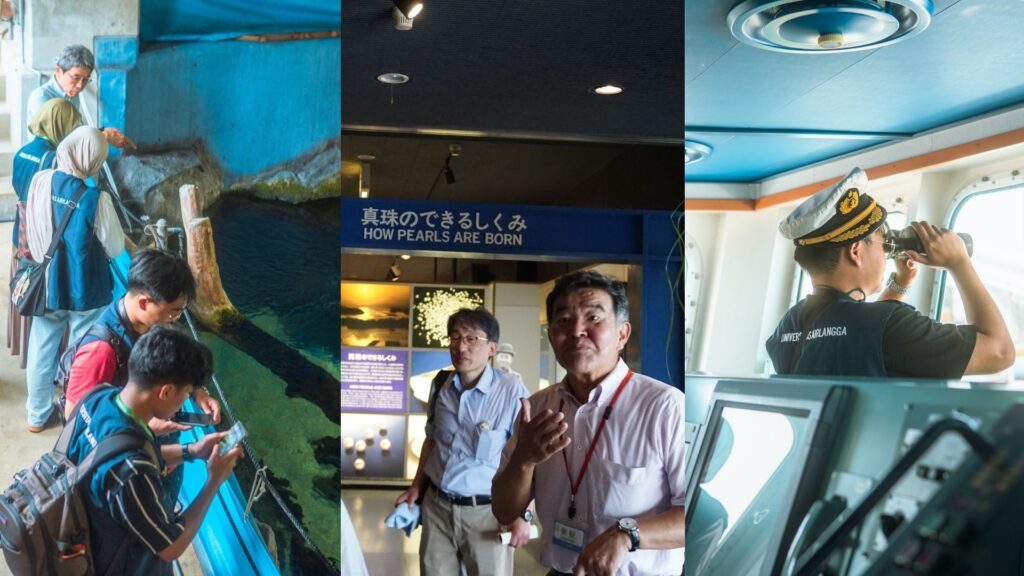
(Left) Participants of BBK 8 International UNAIR toured Toba Aquarium, Friday, (17/07). (Middle) Director of Mikimoto Pearl Island explaining the company’s pearl history on the same day. (Right) Student on board of Seisuimaru Training Ship, Thursday, (23/07) (BBK 8/Mie PDD)
For the first time, Universitas Airlangga (UNAIR) sent a delegation for the International Belajar Bersama Komunitas (BBK) program to Mie University (Mie-U), Japan, from 14 to 27 July 2026 as part of the eighth BBK program. The delegation comprised 24 students and two faculty supervisors, marking the first student-level collaboration between the two universities following an initial meeting between faculty members in 2023.
Led by supervisors Dr. Nurina Hasanatuludhhiyah, dr., M.Si., from Faculty of Medicine, Universitas Airlangga and Prof. Tetsuya Kimura from Graduate School of Bioresources, Mie University, the program strives to bridge academic learning with real-world community needs through academic and industrial visits, cultural exchange, and collaborative initiatives. It promotes mutual learning and intercultural competence while contributing to the Sustainable Development Program (SDG).
Mie Prefecture, particularly Mie University in the city of Tsu, shares several similarities with Universitas Airlangga in Surabaya. As a coastal region with strong expertise in marine and aquatic research and a leading institution in medical education through Mie University Hospital, it provides an ideal setting for interdisciplinary and community-based learning. These shared strengths make Mie an excellent partner for academic collaboration, allowing students to exchange knowledge, explore best practices, and gain insights that can be adapted to address challenges in Indonesia.
Learning From Japan’s Healthcare System
With more than half of the participants coming from the Faculty of Medicine, the program offered extensive learning opportunities aligned with medicine and healthcare. Students visited Mie University Hospital, where they toured various departments, including inpatient wards and operating theaters, under the guidance of Sancho Narushima. They also gained valuable insights into Japan’s super-aging society through visits to Suzuka Chuo General Hospital and Sakuranomori Nursing Home, where they learned about geriatric and palliative care. In emergency medicine, students observed Japan’s highly organized emergency medical services, including civilian-operated helicopters and technologically advanced ambulances that enable rapid, year-round emergency response. While Japan’s healthcare infrastructure is generally more advanced than Indonesia’s, students found that the overall referral system follows a similar framework, offering a familiar point of comparison despite differences in resources and capacity.
Environmental Sustainability in Practice
During a guided tour of the Yokkaichi Pollution and Environmental for Future Awareness Museum, they learned about the city’s rapid industrialization, the severe pollution crisis it once faced, and its transition toward environmental sustainability. The museum highlighted how strong government policies, scientific research, corporate accountability, and community participation worked together to reverse decades of environmental degradation.
As a coastal prefecture, Mie has developed a strong commitment to marine conservation through public education, scientific research, and sustainable resource management. At Toba Aquarium, students were welcomed by its president, Fumiya Nakamura, and learned how the institution integrates marine conservation, scientific research, and interactive educational programs to foster environmental awareness among younger generations. Complementing this experience, students also visited Mie University’s Seisuimaru Training Ship, where they explored the vessel’s role in marine biological research, oceanographic surveys, and fisheries education. Their understanding of sustainability was further enriched at Mikimoto Pearl Island, where sustainable pearl cultivation is carried out alongside the preservation of the centuries-old tradition of the Ama divers. Together, these experiences demonstrated how education, research, environmental stewardship, and cultural heritage can work hand in hand to promote the sustainable management of marine ecosystems while supporting local communities.
Innovation in Agriculture and Industry
At Mie University’s Farm Station, students explored sustainable agricultural practices by learning about Japan’s major agricultural commodities, comparing farming methods with those in Indonesia, and discussing research on the utilization of sago palms and their by-products. They also observed the university’s smart farming system, where drones and precision technologies are used to improve efficiency and reduce labor demands. The learning experience continued with visits to the Toyota Commemorative Museum of Industry and Technology and Taiyo Kagaku. At Toyota, students traced Japan’s transformation from the textile industry to becoming a global leader in automotive manufacturing, while at Taiyo Kagaku they gained firsthand insight into how research and development drive the creation of innovative products. These demonstrations showed how scientific research, technological innovation, and continuous improvement contribute to sustainable agriculture and competitive industries.
Cross-Cultural Learning
Both Indonesia and Japan are influenced by their culture on various lines of work. This BBK program offered multiple cultural and educational exchange opportunities, including tours at Nagoya University Nobel Prize Museum and Mie University. Students met both local and international students there, discussing their work, daily life, and the environment they’re in. It was also a chance to introduce Indonesia, particularly UNAIR in Surabaya, to people that have never met an Indonesian before, like in Ueno High School. The interaction served as cross-cultural communication and a way to exchange experiences in different education systems.
Throughout the program, students witnessed how the SDGs are implemented across sectors. Visits to hospitals and nursing homes reflected SDG 3 (Good Health and Well-being), while environmental initiatives at the Yokkaichi Museum, Toba Aquarium, Seisuimaru Training Ship, and Mikimoto Pearl Island highlighted SDGs 11 (Sustainable Cities and Communities), 12 (Responsible Consumption and Production), and 14 (Life Below Water). Learning at Mie University’s Farm Station and visits to Toyota Museum and Taiyo Kagaku demonstrated innovation in agriculture and industry, supporting SDGs 2 (Zero Hunger) and 9 (Industry, Innovation and Infrastructure). Meanwhile, cultural and academic exchanges with schools and universities in Mie and Nagoya advanced SDG 4 (Quality Education) and fortified international cooperation in line with SDG 17 (Partnerships for The Goals).
Over two weeks in Japan, students gained valuable academic, cultural, and professional insights that broadened their global perspective. Beyond the learning experience, the program strengthened the partnership between Universitas Airlangga and Mie University, laying the foundation for future collaborations and inspiring students to create meaningful impact in their own communities.
Writers: Raisya Isnindira Novery (111231115) and Vanessa Charlize Njotoprajitno (111231265)