
UNAIR International BBK 8 Students Explore Environmental Reclamation Through Policy-Making in Yokkaichi and Learn the Importance of Research and Development at Taiyo Kagaku
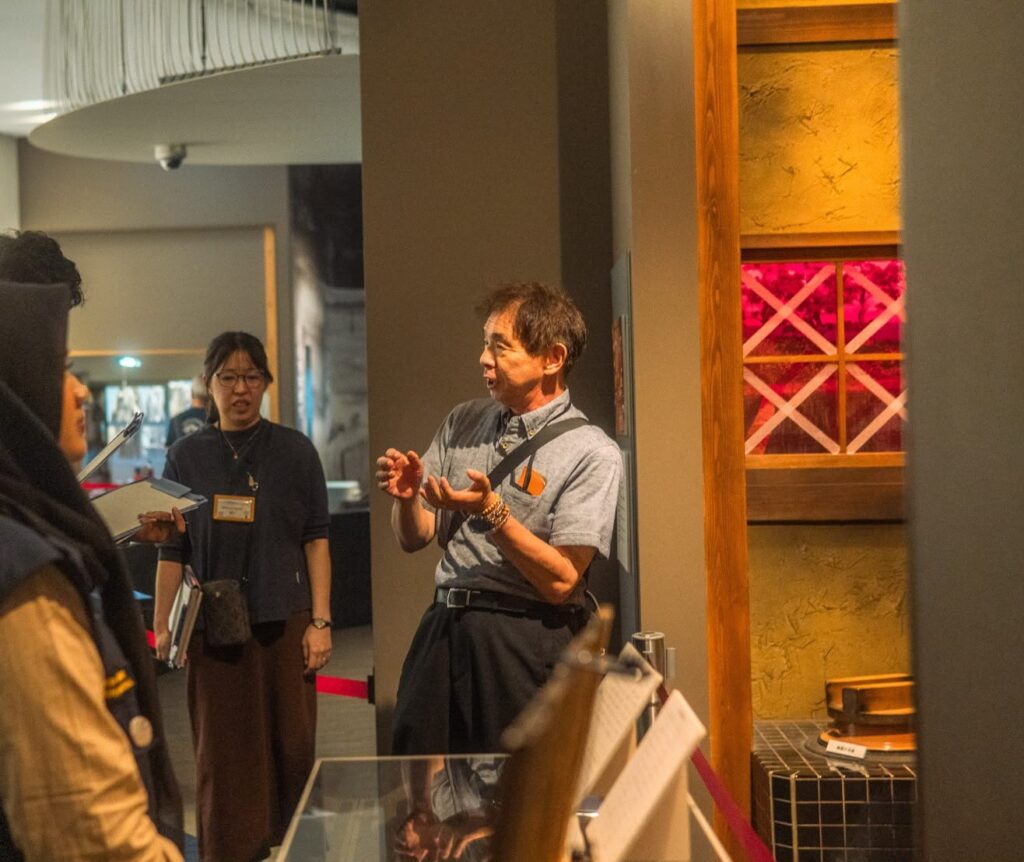
Museum staff explains the history of Yokkaichi’s rapid industrialization at Yokkaichi Pollution and Environmental for Future Awareness Museum in Yokkaichi City, Mie, Friday, (24/07) (BBK 8/Mie PDD)
As a country with long history of industrialization, Japan is not exempt from pollution issues. To learn more about this issue, the students of BBK International 8 Program of Universitas Airlangga visited the Yokkaichi Pollution Museum. The students were guided by the museum’s guide to learn how one of Japan’s most polluted cities once overcame its problem.
One of the cities with the most remarkable history of the pollution issue is Yokkaichi, which was once Japan’s leading industrial cities. The city’s main industries were mainly the wool industry at first. As Japan entered its war-time regime, the city shifted to be a military industrial base, handling large amounts of fuel used for war. This continued through the 1950s until around the mid-1960s. In 1966, the pollution was so heavy that a massive amount of respiratory disease began to appear in the city. It is also said that a large amount of the fish smell bad because of the pollution in the water, which causes digestive issues as well.
It was until society and academics began to state their concerns that the government eventually agreed to sign an agreement to combat the city’s issues. This moment was Yokkaichi’s first step in becoming a pioneer as an industrial city who combats pollution. Up until this moment, the city is still trying to find a way to reduce the pollution while maintaining economical efficiency.
Yokkaichi history tells the importance of building an industry which considers the life of both human and environment. This aligns with The United Nation’s Sustainable Development Goals (SDGs) number 11, Sustainable Cities and Communities. This is achieved through the city’s success in reducing the disaster caused by the city’s severe pollution. Furthermore, the city’s efforts in its innovation to combat the pollution issues also align with the SDGs number 7 (Affordable and Clean Energy) and number 12 (Responsible Consumption and Production). This story of Yokkaichi’s success was not a product of only academics and experts’ concern, but also about how governments use their people’s voice to declare a serious issue in the country.
While Yokkaichi’s pollution issue shows the path of recovery from an environmental catastrophe through regulations. The visit to Taiyo Kagaku shows the importance of research and development (RnD) for better, more sustainable product. At Taiyo Kagaku, the staff presented their product lineup along with the brief mechanism and purpose behind each item. For example, fiber has long been one of the most deficient dietary components in people’s diets, yet taste and texture often make it difficult to incorporate into food. Taiyo Kagaku developed a product that tackles precisely this issue. Through this, UNAIR students learned the importance of research and development in producing better products, rather than blindly creating solutions for non-issues, aligning with SDG 9 (Industry, Innovation, and Infrastructure) and SDG 3 (Good Health and Well-being). Furthermore, exchanging information with international staff at the factory offered deeper insight into Japan’s work culture, in which every individual is valued and embodies the spirit of mutual help. Hopefully, this experience will encourage students to think more critically about the issues around them and, in turn, develop accurate and precise solutions.
Through both the Yokkaichi pollution disaster and the visit to Taiyo Kagaku, Indonesia can draw valuable lessons for addressing its own environmental pollution. Reflecting on Greater Jakarta (Jabodetabek), its rapidly urbanizing areas continue to release pollution through vehicles, factories, and other sources. This pollution has been associated with rising cases of pneumonia in Depok. The lessons learned from Yokkaichi, hopefully, could help save more lives and improve the quality of life for those affected.
This news supports SDG 3 (Good Health and Well-being), SDG 6 (Clean Water and Sanitation), SDG 8 (Decent Work and Economic Growth), SDG 9 (Industry, Innovation, and Infrastructure), SDG 11 (Sustainable Cities and Communities), SDG 13 (Climate Action), and SDG 17 (Partnerships for the Goals).
Writers: Ikhsan Iskandar (111231113) and Ferdyan Hanifa Maheswara (111231189)